
San Marcos, CA
Home MenuCommunity Wildfire Mitigation
Para traducir esta página, vaya al ícono del globo terráqueo en el tema de esta página para Google Translate.
It is the fire department’s goal to reduce the possibility of a major wildland fire in San Marcos. Click here to view how the San Marcos Fire Department facilitates wildfire preparedness.
Hazard Mitigation
One of the ways the department is prepared for wildfires is through a vegetation management program.The City of San Marcos has an ordinance that prohibits the accumulation of weeds, grass and vegetation. To assist our citizens in complying with this ordinance, the fire department has an annual vegetation management program in which properties are inspected to reduce overgrowth of such hazards.
The fire department responds to all citizen inquiries that deal with fire and life safety issues. This helps reduce potential hazards while increasing the livability of the community that we live in.
To report hazardous weed conditions within the City of San Marcos, or if you have questions about abating weeds on your own property, please call (760) 744-1050, ext. 3409.
Resources to help prepare for a Wildfire
- Defensible Space
- Plant List
- CAL FIRE Fire Hazard Severity Zone Map - San Marcos
- CAL FIRE Fire Hazard Severity Zone Map - San Diego County
- Fire Hazard Severity Zone Viewer (arcgis.com)
- CAL FIRE Low Cost Fire Resistive Construction Retrofit List
- State Fire Marshal Listed Wildland Urban Interface (WUI) Products Handbook Updated 09/20/2024
Are you wildfire prepared?
Throughout California, wildfire danger is a year-round threat. Emergency preparedness is a top priority and the City of San Marcos is committed to keeping the community safe, especially during a disaster.
Residents are an important part of emergency planning and preparedness. These simple steps can help protect you, your family and property from wildfire.
Maintain Defensible Space 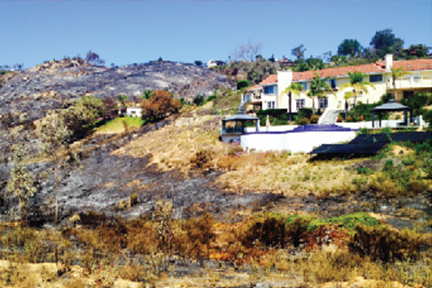
Defensible space is an area around a structure where fuels and vegetation are treated, cleared or reduced to slow the spread of wildfire towards the structure.
Defensible space provides room for firefighters to effectively and safely defend a structure and reduces the chance of a structure fire moving from the building to the surrounding vegetation.
Reducing fuel loads and vegetation around a home greatly improves the survivability of a structure during a wildfire. Be sure to provide clearance and choose appropriate fire-resistant plantings.
Manage your landscape 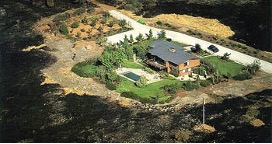
Keep the fuels and vegetation area 30 to 50 feet immediately around a home or structure treated, cleared or reduced to slow the spread of wildfire. Drought tolerant and fire resistive plants are the best choices for this area. If you think your property contains rare, threatened or endangered species or sensitive habitat, contact the City’s Planning Division at (760) 744-1050, ext. 3237.
Reduce Fuel Zone
Within the remaining 70 to 150 feet* of defensible space, plants should be horizontally and vertically spaced, and native vegetation should be thinned. Lower tree branches at least six feet from the ground should be removed.
(*Minimum of 100 feet from structures built prior to January 1, 2004 and 150 feet for those built after.)
Check your structure
- Decks, patios and fences: Limit combustible structures attached to your residence – such as decks, patios and fences.
- Wood piles: Keep combustible debris such as stacked wood piles away from your home’s walls.
- Dead leaves: Remove dead leaves and other debris from under solar panels, eaves and gutters.
- Tree branches: Dead tree branches hanging over a roof should be cut back. State Fire Marshal Listed Wildland Urban Interface (WUI) Products.
Keep access open
- Address visibility: Make sure your home address is posted on a highly contrasting background and clearly visible from the street, especially at night.
- Clear vegetation: Clear flammable vegetation to at least 10 feet from roads and cut back overhanging tree branches.
- Turnarounds: Keep turnarounds on dead-end roads and long driveways clear for emergency vehicles.
Have an evacuation plan
- Evacuation plan: Your plan should include escape routes out of the wildfire area and a meeting place.
- Exit routes: Identify at least two exit routes from your home and neighborhood.
- Consideration: Should be given to pets, important documents, medication, and irreplaceable items.
Know your emergency numbers
- 9-1-1: If you see fire or smell smoke, your first line of defense is calling 9-1-1.
- REVERSE 9-1-1: Register your cell phone for Reverse 9-1-1 emergency calls via Alert San Diego by visiting www.AlertSanDiego.org.
Protect your home
- Roof: Roof or re-roof using non-combustible materials such as composition, metal or tile.
- Vents: Ensure vents are ember-resistive to prevent the intrusion of flying embers.
- Eaves and soffits: Ensure eaves and soffits (arches, overhangs and balconies) are protected with non-combustible materials.
- Windows: Windows should be dual-paned with one pane of tempered glass to reduce the chance of breaking during a fire.
- Walls: Walls should be built with ignition-resistant materials such as stucco, fiber cement, stone veneer or fire-retardant treated wood.
- Decks: Ensure decks within 10 feet of a building are built with ignition-resistant or non-combustible materials.
Stay connected
Residents should register all cell phones with AlertSanDiego, to receive emergency notifications.
During an emergency, residents should stay updated on the latest local safety information by visiting the City’s website; following the City on Facebook, Twitter and Instagram with the handle @sanmarcoscity; registering for e-notifications; and turning radios to AM 1610.
Resources
- Animal Evacuation: Evacuation for Household Pets and Horses
- Before, During & After Wildfire
- Alert SD County - 4 Steps to Disaster Preparedness
- Wildfire Preparedness Guide
- Fire Department Wildfire Preparedness
- Preparing Homes for Wildfire
- Wildfire Safety
- CAL FIRE - READY, SET, GO!
- Fire Hazard Severity Zone Viewer - LRA
Visit: San Marcos FD - Disaster Preparedness
| San Marcos Fire Department |
DEPUTY FIRE MARSHAL | Fire inspector |
|---|---|---|
| 1 Civic Center Drive San Marcos, CA 92069 |
Kenneth Kim (760) 744-1050, ext. 3409 |
Jessica Madson (760) 744-1050, ext. 3409 |


